Ghana Must Turn Agribusiness Potential into Productivity — Agri-Impact Deputy CEO Urges Bold Reforms

|
Getting your Trinity Audio player ready...
|
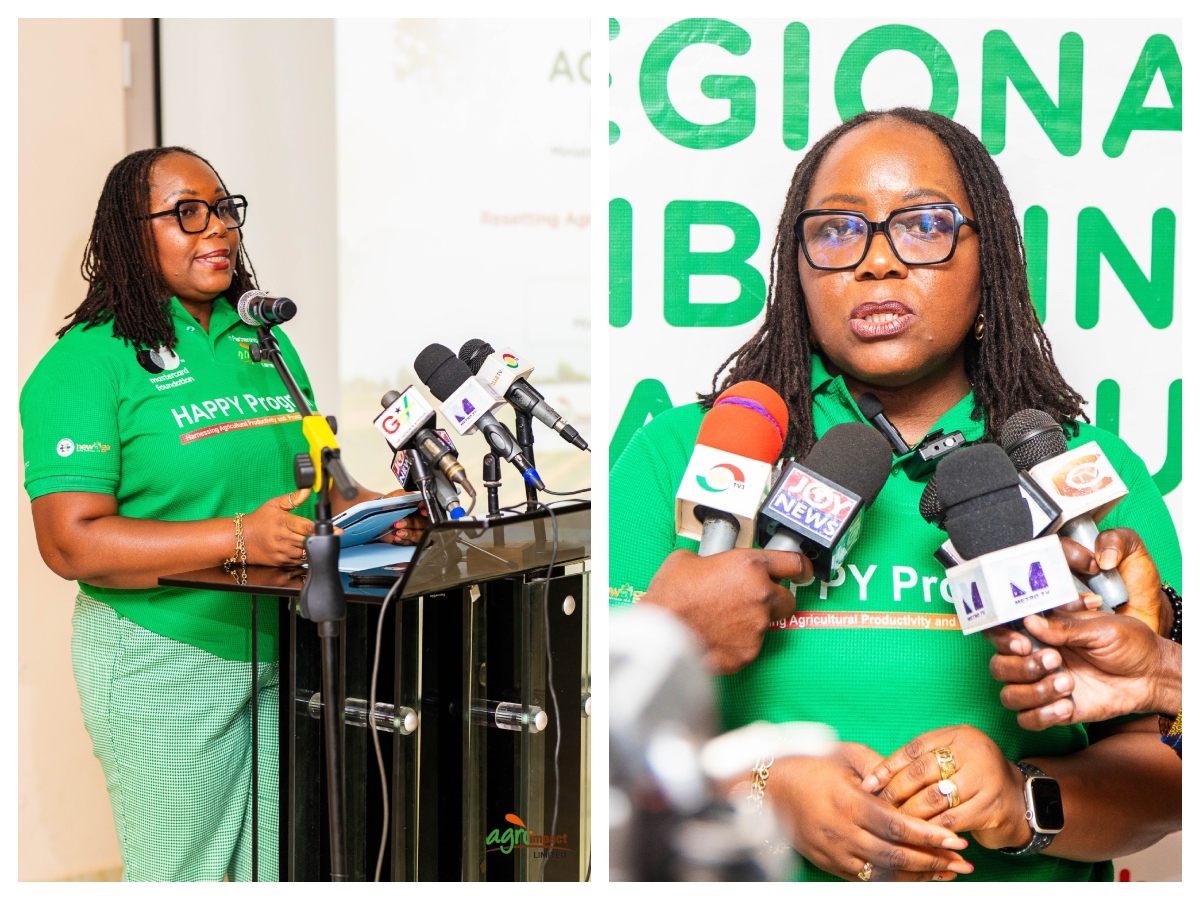
The Deputy Chief Executive Officer of Agri-Impact Limited, Mrs. Juliana Asante-Dartey, has made an impassioned call for Ghana to unlock the transformative power of agribusiness and use it as a cornerstone for inclusive and sustainable industrial growth.
Speaking under the theme “Resetting Agribusiness for Inclusive and Sustainable Industrial Growth” at the Regional Agribusiness Dialogue in Sunyani on Monday, October 13, 2025, Mrs. Asante-Dartey emphasized that Ghana’s vast agricultural potential must be matched with deliberate action and bold policy shifts.
“The importance of agribusiness and its transformative power in our economy cannot be overstated. It is indeed the key to unlock jobs and wealth for our nation,” she stated. “We have no excuse for where we find ourselves. The challenge is how do we turn this potential into productivity, and how do we turn our capacity into better coordinated outcomes?”
She called on stakeholders to confront the hard truths about the sector’s inefficiencies, urging policymakers to create frameworks that reflect the realities faced by farmers and agribusiness operators across regions, not just in Accra. “Are our current policies fully fit for purpose? Are they inclusive of young people, women, and persons with disabilities?” she asked.
Mrs. Asante-Dartey also stressed the importance of environmental sustainability and digital innovation in modern agribusiness. “As we grow, we have seen the emergence of AI and the role of technology. We have to be sure that policies are not afterthoughts,” she added.
Using her experience traveling to the Bono Region, she highlighted the toll of poor road infrastructure on agribusiness operations. “Even for me, just being in the car was tough. So I am imagining if you have to send day-old chicks from here [Sunyani] to Accra or bring in produce. The impact on business is not just the inconvenience, it’s also the cost and lost productivity.”
Citing statistics, she revealed that Ghana loses between 20 to 50 percent of harvested produce before it reaches the market, a situation she described as economically devastating. “We are losing over $2 billion worth of food annually, and nearly the same amount in post-harvest losses. Combined, that’s over $3 billion every year in lost income and foreign exchange,” she lamented.
Mrs. Asante-Dartey illustrated the power of value addition with an example: “A kilo of bifonia sells for $2, but when processed into an active ingredient, it can go as high as $100. The multiplier is enormous. If we stop at raw production, we lose out completely.”
She urged government and the private sector to work together to create an enabling environment for agribusinesses to thrive. “We must reward productivity and not promote import dependency,” she noted, criticizing the high cost of borrowing, weak enforcement on imported goods, and low government alignment with local production.
Apart from policy, she called for a shift in mindset among Ghanaians. “As we demand better quality from our local producers, are we willing to patronize their products and pay a little extra to support them? Every cedi spent on imports is a cedi lost in jobs, innovation, and national wealth,” she emphasized.
Mrs. Asante-Dartey proposed the creation of a dedicated Agri-Fund, similar to the GETFund and NHIS, to support the financing needs of the sector. “If we truly believe agriculture is the engine for transformation, then we must establish an Agri-Fund that is dedicated to agribusiness advancement,” she said.
She also highlighted the need to bridge the gap between research and industry. “Our research must address real-world problems and provide practical solutions that enhance productivity. We must pull our resources and expertise together to solve the challenges of the agribusiness sector.”
Adding to her remarks, the Deputy Minister for Trade, Agribusiness, and Industry, Hon. Sampson Ahi, described the regional consultation as a vital step in Ghana’s collective effort to transform the agribusiness landscape.
“This consultation marks a crucial moment in our shared mission to transition our country from an agrarian economy to an industrialized one,” he stated, noting that the inclusion of Agribusiness in the Ministry’s portfolio was deliberate to promote value addition across agricultural value chains.
He pointed out that the global agribusiness market, valued at up to $3.5 trillion in 2024, is projected to reach nearly $5.8 trillion by 2033. “We can position ourselves to harness this growth through investment in innovation, sustainable practices, contract commercial farming, and value-added processing,” he said.
The minister announced that government is pursuing a two-pronged strategy to promote agro-industrialization: waiving taxes on agro-processing machinery in the short term to attract investment, and retooling local manufacturing capacity in the medium to long term through partnerships with institutions such as GRATIS Foundation and the International Fund for Agricultural Development (IFAD).
“These measures will strengthen local capacity to design, manufacture, and repair agro-processing machines, reducing dependence on imports and stimulating innovation in the machinery manufacturing sector,” he said.
He further revealed that the Ministry is developing a comprehensive Agribusiness Policy aimed at improving value chains, promoting high-quality raw material production, and supporting agro-processing industries. The policy, he explained, will emphasize sustainability, productivity, and export competitiveness while ensuring job creation and inclusivity.
“As we work towards resetting our nation, I urge all Ghanaians to recognize the enormous benefits the agribusiness sector can bring to our economy,” the minister concluded. “This requires a collective effort from every citizen. If we work together, we can reset our economy, creating a stable and thriving environment that benefits everyone.”